THE PRIMAL JOURNAL / Knowledge
Best AI Tools for Product Managers in 2026
A practical shortlist of AI tools for product research, meetings, roadmap execution, feedback, specs, analytics, and customer interview synthesis.
Who this is for: product managers and Heads of Product on B2B software teams who already live in Linear, Notion, Slack, and a CRM — and who keep getting sold another all-in-one AI PM platform.
How we ranked: we sorted tools by the job they actually finish in a normal week (research, meetings, roadmap and execution, specs, feedback). For each job we used four criteria: grounded answers with sources; handoff into the team’s system of record; permission and audit trail; time-to-value under two weeks. We leaned on vendor docs, public 2026 stack roundups, and open r/ProductManagement threads where PMs describe what broke in production.
What product managers are actually buying AI for?
Most “best AI tools for product managers” lists dump twenty logos into one bucket. Stacks keep growing while context stays thin.
On Reddit, the pain is oddly specific. One Head of Product described drowning in Linear plus Slack plus Figma plus HubSpot and asked how to keep a single thread of truth. Another thread asked how to build a “project brain” across PRDs, research, meetings, and data without becoming a full-time copy-paste operator. A third asked for project context without switching between a dozen tools.
The pattern underneath those posts is simple: AI helps when it finishes a job inside a clear system of record. AI fails when it invents a thirteenth inbox.
Which AI tools win for which product job?
Use this as a shortlist. Best for names the job. Choose it when names the team shape. Skip anything that only looks good in a demo.
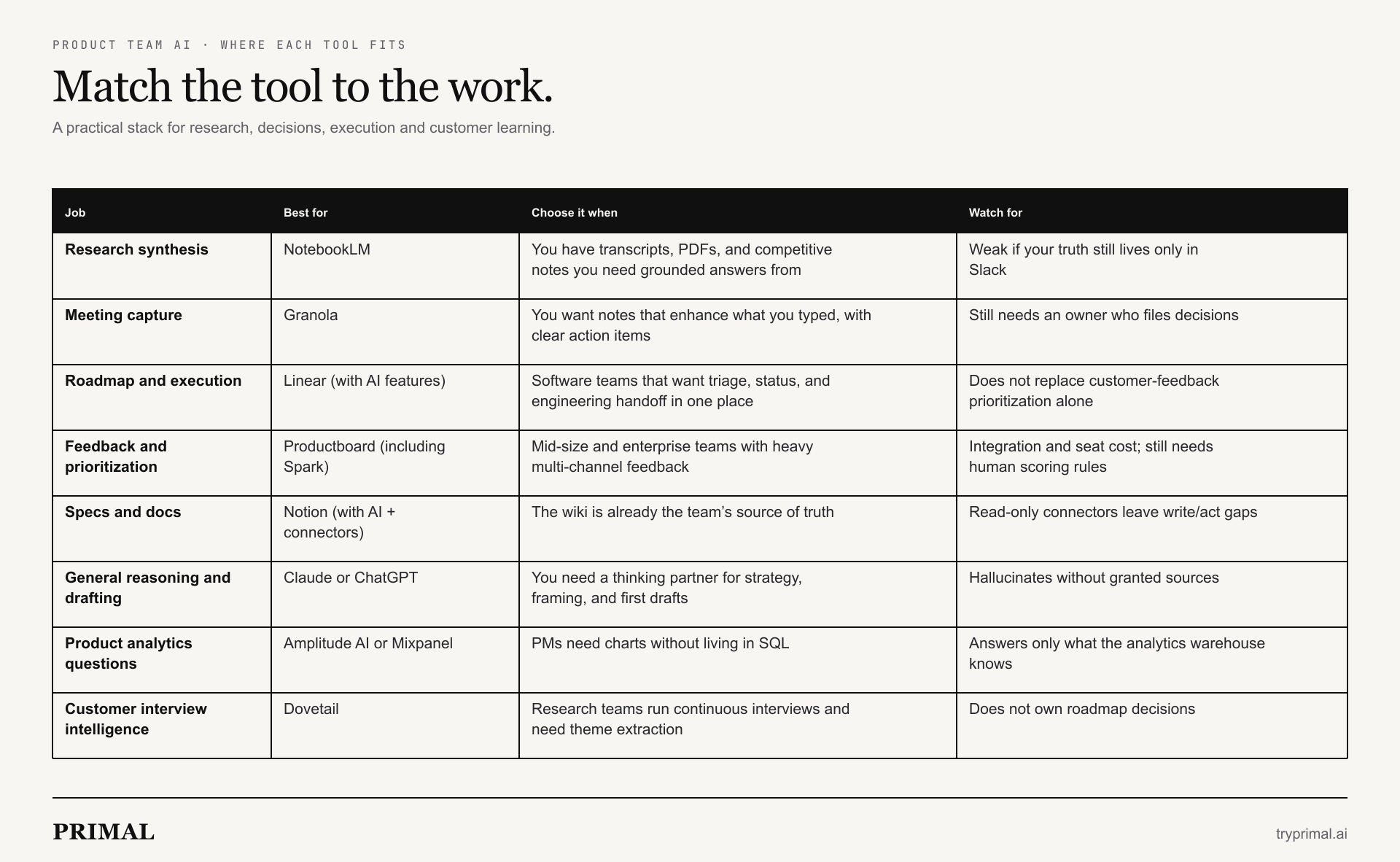
| Job | Best for | Choose it when | Watch for |
|---|---|---|---|
| Research synthesis | NotebookLM | You have transcripts, PDFs, and competitive notes you need grounded answers from | Weak if your truth still lives only in Slack |
| Meeting capture | Granola | You want notes that enhance what you typed, with clear action items | Still needs an owner who files decisions |
| Roadmap and execution | Linear (with AI features) | Software teams that want triage, status, and engineering handoff in one place | Does not replace customer-feedback prioritization alone |
| Feedback and prioritization | Productboard (including Spark) | Mid-size and enterprise teams with heavy multi-channel feedback | Integration and seat cost; still needs human scoring rules |
| Specs and docs | Notion (with AI + connectors) | The wiki is already the team’s source of truth | Read-only connectors leave write/act gaps |
| General reasoning and drafting | Claude or ChatGPT | You need a thinking partner for strategy, framing, and first drafts | Hallucinates without granted sources |
| Product analytics questions | Amplitude AI or Mixpanel | PMs need charts without living in SQL | Answers only what the analytics warehouse knows |
| Customer interview intelligence | Dovetail | Research teams run continuous interviews and need theme extraction | Does not own roadmap decisions |
What should sit in a core 2026 PM stack?
A practical core for many B2B product teams looks like this:
- Linear for issues and shipping status.
- Notion for specs, decisions, and the living wiki.
- NotebookLM for synthesizing interviews and long docs with citations.
- Granola for meeting capture.
- Claude or ChatGPT for drafting and structured thinking.
- Amplitude or Mixpanel for product questions.
- Productboard or a disciplined Notion database when feedback volume is high.
That stack matches what experienced PMs report using in 2026 public roundups. It also matches the Reddit advice that keeps showing up: build an intelligent layer on top of tools the team already uses, instead of forcing a migration into yet another workspace.
How should you evaluate an AI PM tool in a one-week pilot?
Ask five questions before you buy seats.
- Where does the system of record live after the answer? If the answer dies in chat, you bought a demo.
- Can it cite the page, ticket, or call it used?
- What can it read versus draft versus send versus change — and who confirms the irreversible step?
- Does it inherit real permissions, or does it see everything the integration token can see?
- What happens when two sources conflict?
If a vendor cannot answer those in plain language, keep the specialist tools you already trust.
When does the stack stop being enough?
Specialist AI tools are strongest when the truth and the action already live in one gravity well — Notion for docs, Linear for engineering, Productboard for feedback, Amplitude for product metrics.
Product work often leaves that gravity. A sales objection in HubSpot changes a roadmap bet. A Slack decision needs a ticket, a CRM note, and a customer email. A status update needs sources from three systems and an owner who will stand behind the number.
That is the gap Reddit keeps describing as the missing “project brain”: not another roadmap UI, but a way to pull context across systems, draft the next step, and keep a human on anything consequential.
If your recurring pain is work that has to change records across systems with sources and an owner, an operational layer across those systems is worth a look. Primal is one option for that layer.
How do you choose without buying the whole category?
Start with the job that wastes the most hours this month.
- If interview synthesis is the bottleneck, start with NotebookLM.
- If meeting notes never become decisions, start with Granola plus a Notion decision log.
- If engineering status is the fire drill, deepen Linear before you buy another PM suite.
- If feedback is drowning the roadmap, evaluate Productboard against a strict Notion intake database.
- If the pain is cross-system chase — Slack, CRM, tickets, wiki — shortlist tools that read with sources, draft with owners, and refuse silent writes.
Buy the tool that finishes this month’s bottleneck job.