THE PRIMAL JOURNAL / Knowledge
Best Slack Helper AI Tools in 2026
A practical evaluation guide for comparing Viktor, Lindy, Helm, Prio, Roman, and other Slack AI coworkers.
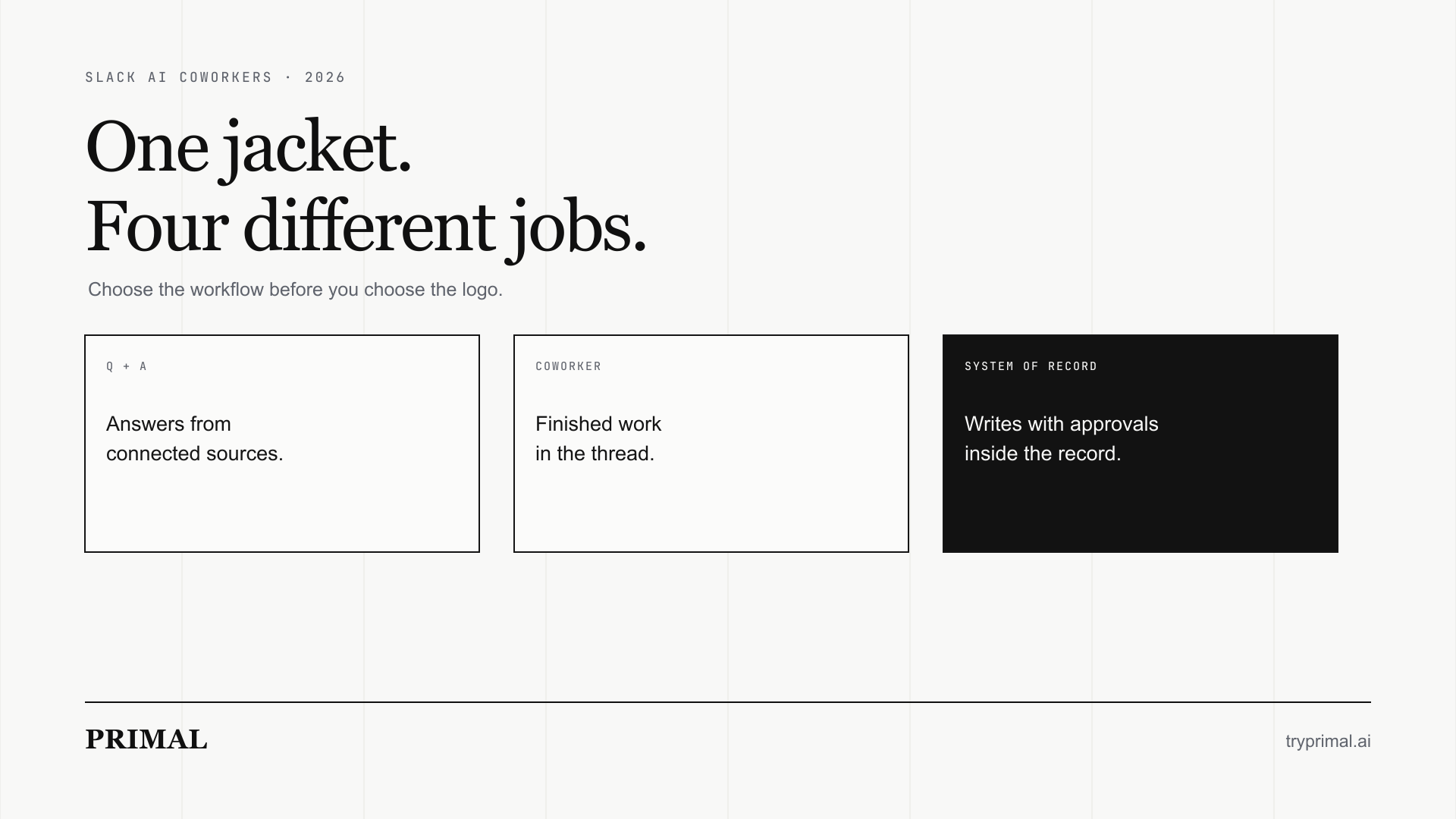
“AI in Slack” now covers four different products wearing the same jacket: chat Q and A bots, personal chief-of-staff agents, shared AI coworkers that deliver finished work, and platforms that want to become your system of record.
Department heads feel the confusion in procurement. Every vendor demo looks like a win because the RFP mixed “answer questions,” “draft in thread,” “finish multi-step work,” and “write to CRM with approvals” into one line. McKinsey’s State of AI and agentic-organization work keeps pointing at the same fix: redesign the workflow around human–agent teams with clear ownership, then buy the tool that fits that workflow. Gartner’s two thousand twenty-five agentic press notes add the blunt risk line — agents are spreading into enterprise apps fast, while projects without clear value and governance still get canceled at scale.
This guide helps founders and department heads shortlist Slack helper AI tools with a clean criteria set — including Viktor, Lindy, Helm, Prio, Roman, and Jessie-class peers. Skip fake ROI claims. There is no universal winner for every company.
What “Slack helper” should mean for your pilot
Pick the meaning before you pick the logo. Write one sentence that ends with a finished artifact or a refused action.
- Answer questions from connected sources with citations or links back to truth
- Draft messages and summaries in-thread for a human to send
- Run multi-step work and drop finished files (reports, decks, dashboards, code)
- Act in CRM / tickets / calendars / billing with approvals on irreversible steps
- Own recurring jobs on a schedule with a pause until someone approves the skill
If your RFP mixes all five, every demo will look like a win and every quarter will look like a mess. McKinsey’s lighthouse-workflow advice applies here: one job, one owner, one definition of done.
Criteria operators actually use
- Shared coworker vs personal assistant — Whole-team ping in channels, or a seat that knows one person’s inbox and calendar deeply.
- Finished work vs chat answers — Can you point at a file, PR, CRM change, or scheduled job the agent produced last week?
- Approval gates and audit trail — Inline confirm, dedicated queue, action log, named approver. Who owns the irreversible step?
- Integration breadth vs depth in your actual stack — Three thousand connectors mean little if your Attio / HubSpot / NetSuite path is weak. Depth on the systems you use beats a long logo wall.
- Pricing predictability — Seat vs credit vs platform. Model a busy week and a quiet week. Ask about rollover, top-ups, and what happens at zero credits.
- Where memory lives — Channel, workspace, personal profile, or platform records. Shared memory changes access design.
- Access inheritance — Does one teammate’s OAuth grant become team-wide? Can personal connections stay personal?
- Cert and residency needs — Type I vs Type II, GDPR / EU residency, HIPAA where your buyer requires it.
Side-by-side
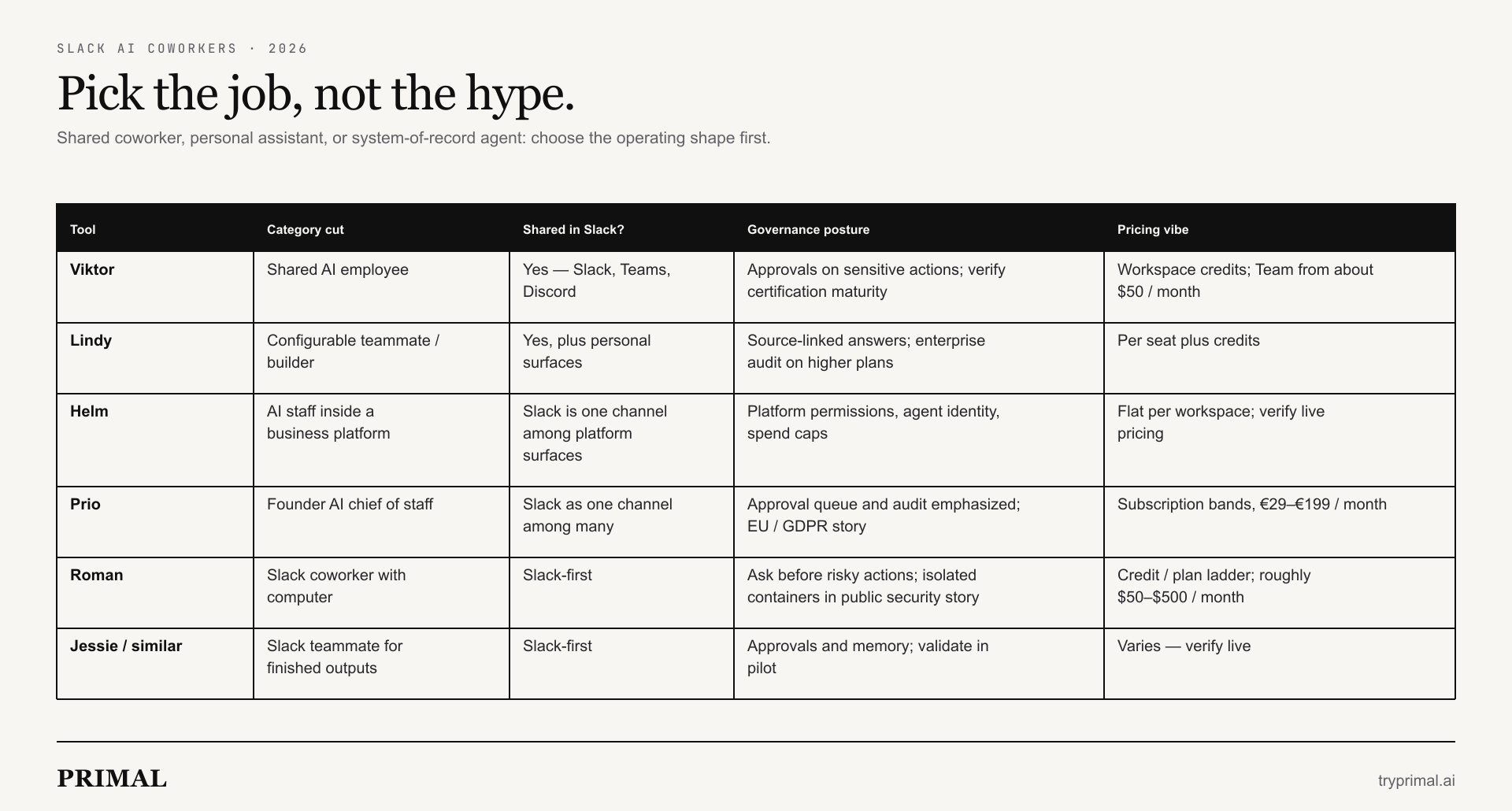
| Tool | Category cut | Shared in Slack? | Finished work | Governance posture | Pricing vibe |
|---|---|---|---|---|---|
| Viktor | Shared AI employee | Yes (Slack / Teams / Discord) | Strong claim (artifacts, Pages / Spaces, code, scheduled work) | Approvals on sensitive actions by default; check cert maturity | Workspace credits (start free; Team from about fifty dollars / month) |
| Lindy | Configurable AI teammate / builder | Yes (plus personal surfaces) | Strong on meetings, inbox, deliverables | Source-linked answers; enterprise audit on higher plans | Per seat + credits |
| Helm | AI staff inside a business platform | Agents on platform data (Slack is one channel among platform surfaces) | Acts on CRM / projects / billing records | Platform permissions + agent identity + spend caps | Flat per workspace (founding ~seventy-nine dollars / month — verify live) |
| Prio | Founder AI chief of staff | Slack as one channel among many | Email / calendar / CRM / voice-heavy | Approval queue + audit emphasized; EU / GDPR story | Subscription bands (€twenty-nine–€one hundred ninety-nine / month) |
| Roman | Slack coworker with computer | Slack-first | End-to-end finished work claim | Ask before risky actions; isolated containers in public security story | Credit / plan ladder (~fifty–five hundred dollars / month public bands) |
| Jessie / similar | Slack teammate for finished outputs | Slack-first | Reports, decks, campaigns in-thread | Approvals + memory — validate in pilot | Varies — verify live |
Fair notes per tool
Viktor
Who it is for. Teams that already work in Slack or Teams and want one shared hire that pulls from many tools and returns finished work without building a separate agent for every job.
Wins on. Proactive task offers, shared workspace memory, three thousand two hundred plus integrations, finished artifacts (including sendable Pages and internal Spaces), skill training from a screen recording, effort dials that trade depth for cost, and approvals before sensitive actions. Pricing is per workspace, so a quiet week costs less than a noisy one when you stay inside the credit plan.
Friction. Credit burn on heavy or repetitive work; memory slips and verbose answers show up in public reviews; Type II / ISO maturity may still be a security-calendar item depending on the review date you trust; integration inheritance needs deliberate personal-vs-team scoping.
Pilot gotchas. Cap credits day one. Connect only pilot systems. Run five live tasks plus a missing-source refuse and an out-of-policy send. Ask in-channel what the week cost.
Lindy
Who it is for. Operators who need meetings, inbox, calendar, and configurable agents — and who can budget per seat with clearer month-start math.
Wins on. Per-user pricing bands commonly cited in comparison write-ups; source-linked answers; meeting library patterns; builder depth; compliance story often preferred by regulated buyers in public comparisons (Type II on every plan; HIPAA on Enterprise in Lindy’s own materials).
Friction. Seats multiply. Builder culture takes time. Credit pools on some surfaces pause when empty.
Pilot gotchas. Shortlist the right Lindy surface (personal vs shared teammate) before comparing to Viktor. Test conflicted sources. Confirm audit features on the paid plan you will actually buy.
Helm
Who it is for. Service and founder-led businesses ready to consolidate CRM, projects, time, and invoicing so agents act inside the record instead of fetching context from a scatter of tools.
Wins on. System-of-record context, flat workspace pricing with included AI labor on public founding plans, agent inboxes, per-agent spend caps, MCP / CLI for technical operators.
Friction. Waitlist / early access for some workspaces. Fewer niche integrations than Viktor. Wrong fit if you refuse to move systems of record.
Pilot gotchas. One client or one service line only. Cap agent spend. Compare record-aware actions against a Slack coworker fetching the same CRM through OAuth.
Prio
Who it is for. Founders whose operating cadence is email, calendar, CRM hygiene, and voice — with Slack as one surface — and who want subscription predictability plus a dedicated approval queue.
Wins on. Clear euro pricing bands, anticipation engine story, Attio / GitHub depth, EU residency / GDPR posture, multi-channel reach beyond Slack.
Friction. Founder chief-of-staff lane rather than company-wide Slack labor. Different integration philosophy than horizontal coworker tools.
Pilot gotchas. Five days on the founder’s real inbox with approvals on. Count how many actions waited in the queue. Compare anticipation value against a shared Slack coworker on the same calendar week.
Roman, Jessie, and peers
Who they are for. Bake-off mirrors to Viktor: Slack-first finished work, broad connectors, ask-before-sensitive-action defaults.
Wins on. Roman’s public computer-sandbox and credit ladder (Pro from about fifty dollars / month); Jessie’s plain-English teammate framing with finished outputs in thread. Use them when you want a second or third datapoint under identical pilot rules.
Friction. Verify pricing, certs, and spend controls live. Category noise is high — your workflow is the filter.
Pilot gotchas. Same five tasks, same two refuses, same spend cap, same week. Score quality, burn, and security temperature. Keep one.
How to choose (meatier week plan)
- Write the recurring job in one sentence and paste last month’s real artifact that proves “done.”
- Circle shared coworker or personal chief of staff — and stick to that circle for the pilot.
- Circle answers-only or finished work with writes — if you need writes, name the systems and the irreversible fields.
- Set a hard monthly spend and a hard approval rule before anyone connects OAuth. Put the human owner’s name on send / spend / change.
- Connect narrowly — only the systems that job needs. Mark personal vs team integrations deliberately.
- Run five live tasks + two refuses (missing data; forbidden send). Log whether a human still rebuilt the output.
- Review meter or seat burn with finance on day five, not day thirty.
- Keep the tool that finishes under governance. Cut the rest until the next workflow earns its own trial.
That sequence matches how serious operators already run software pilots — and it matches the agentic-organization advice from McKinsey: lighthouse first, portfolio later. It also respects Gartner’s warning that agent projects without clear value and gates get canceled.
Search finds. iPaaS moves. Copilots draft. An operational layer finishes read → draft → act → verify → learn with a human on irreversible steps. Primal is the operational layer that connects your systems so AI can do work alongside your team tryprimal.ai.